
Dear Editor,
Renal cell carcinoma with fibromyomatous stroma (RCC-FMS) is a morphological terminology in an attempt to describe a number of renal neoplasms exhibiting a distinctive biphasic architecture, comprising clear cells arranged in branching tubules and papillary structures within a stroma of smooth muscle-like spindle cells that often express desmin (-). Several renal neoplasms including clear cell renal cell carcinoma (CCRCC), clear cell (tubulo) papillary renal cell tumor (CCPRCT), transcription factor binding to IGHM enhancer 3 (TFE3)/transcription factor EB (TFEB) altered RCC, elongin C (ELOC) mutated RCC, tuberous sclerosis complex (TSC)/mechanistic target of rapamycin (mTOR) pathway mutated RCC (either sporadic or TSC-related), and renal hemangioblastoma (-). These entities may be subject to significant diagnostic challenge and are critical to accurately diagnose due to the fact that a) neoplasms in the category of RCC-FMS have different expected clinical outcomes, for instance CCPRCT is considered benign, whereas CCRCC is malignant (-), b) RCC-FMS related to TSC/mTOR pathway mutations may be associated with germline mutations, i.e. with TSC (, , ), and c) neoplasms in this category have positive expression of carbonic anhydrase 9 (CA9), a key immunohistochemical (IHC) assay for CCRCC, frequently requiring additional IHC, cytogenetics and molecular work-up (-).
Cytogenetics and molecular assays in the diagnosis of renal neoplasms are often inaccessible for surgical pathologists (). A tiered diagnostic approach () is recommended, beginning with morphological features as well as CA9 and keratin 7 (KRT7) staining. A CA9-positive (box-like) and KRT7-negative immunophenotype supports a diagnosis of CCRCC ( a-d). If both CA9 and KRT7 are negative, TFE3/TFEB altered RCC should be considered in the differential diagnosis.
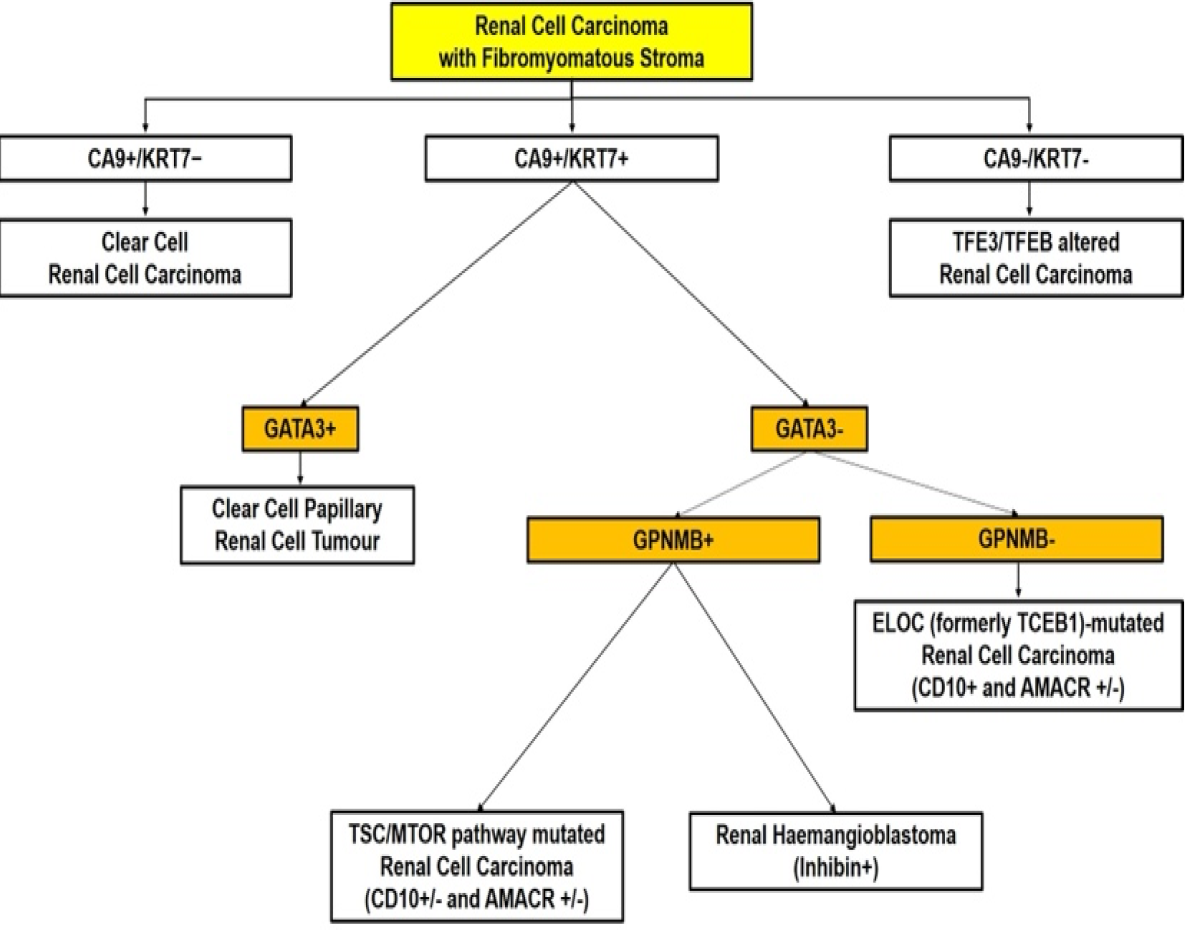
CA9: Carbonic anhydrase 9, KRT7: Keratin 7, GATA3: GATA binding protein 3, GPNMB: Glycoprotein non-metastatic melanoma protein B, ELOC: Elongin C, CD10: Cluster of differentiation 10, AMACR: Alpha-methylacyl-CoA racemase
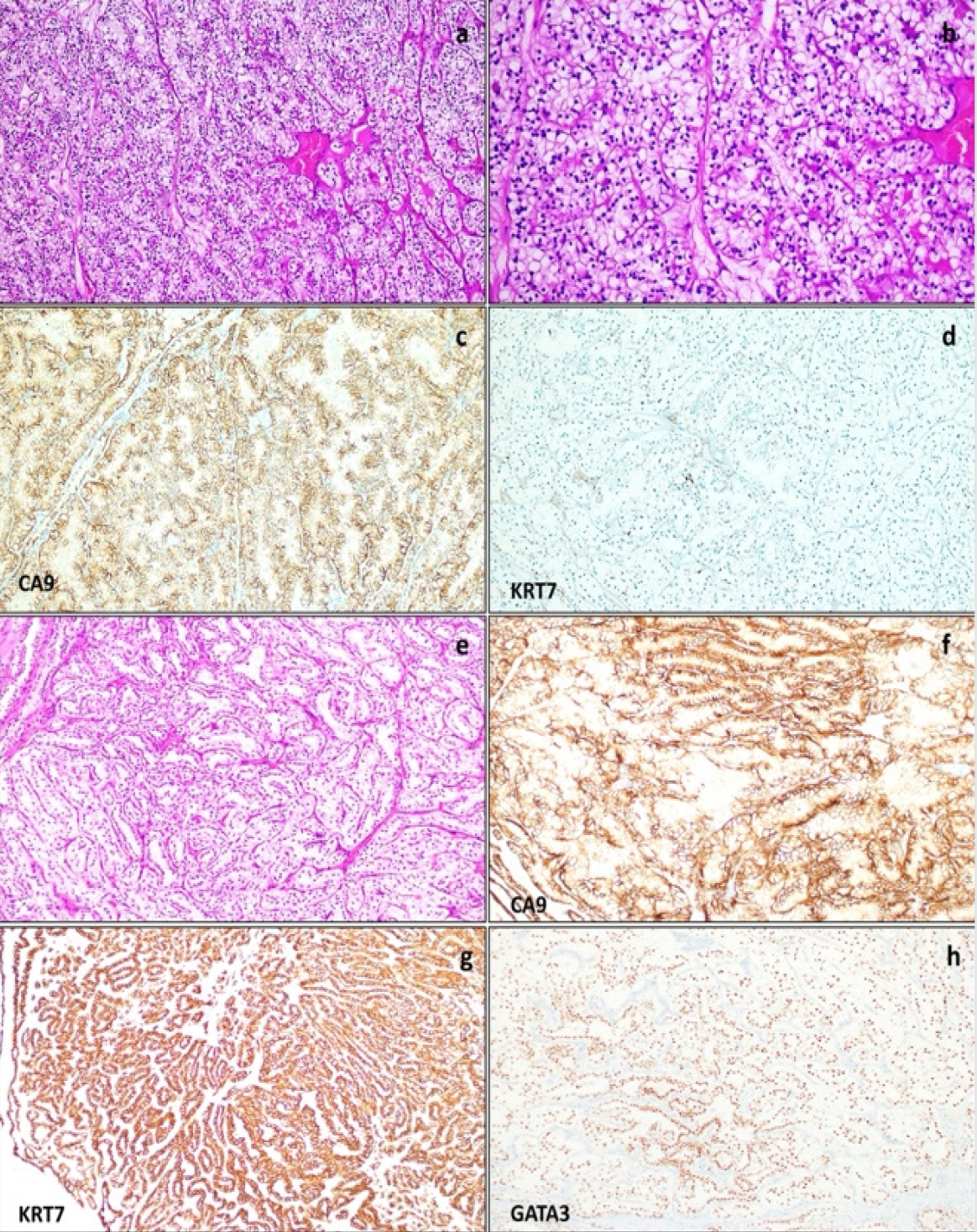
(a,b) Clear cell renal cell carcinoma (CCRCC) shows nests of clear cells (H&E)
(c,d) CCRCC is positive for CA9, with a box-like membranous staining pattern, and negative for KRT7
(e,f) Clear cell papillary renal cell tumor (CCPRCT) exhibits papillary architecture (H&E) and strong CA9 positivity showing a cup-like staining pattern
(g,h) CCPRCT shows diffuse KRT7 and nuclear GATA3 positivity
H&E: Hematoxylin and eosin, CA9: Carbonic anhydrase 9, KRT7: Keratin 7, GATA3: GATA binding protein 3
Co-expression of CA9/KRT7 necessitates further evaluation with an extended panel. A second-tier IHC panel—comprising GATA binding protein 3 (GATA3), glycoprotein non-metastatic melanoma protein B (GPNMB), cluster of differentiation 10 (CD10), and alpha-methylacyl-CoA racemase (AMACR)—can offer valuable diagnostic resolution (, , ). GPNMB—a transmembrane glycoprotein associated with melanocytic and histiocytic differentiation—has emerged as a marker for TSC/mTOR pathway–altered renal neoplasms (). Isolated GATA3 positivity, in the absence of CD10, AMACR, and GPNMB expression, strongly favors a diagnosis of CCPRCT ( e-h). In contrast, diffuse GPNMB expression, with or without weak GATA3 staining and variable CD10 or AMACR expression, supports a diagnosis within the spectrum of TSC/mTOR pathway-related renal neoplasms, including TSC/mTOR-related RCC and renal hemangioblastoma (). A profile demonstrating GPNMB and inhibin co-positivity alongside absent GATA3 is suggestive of renal hemangioblastoma, while CD10 positivity in the absence of both GATA3 and GPNMB raises suspicion for ELOC-mutated RCC (, ). Our understanding in RCC-FMS continues to evolve and requires stepwise algorithmic approach with emerging immunophenotypic markers, along with more utilized and conventional markers, such as GPNMB and GATA3.
Authorship Contributions
Surgical and Medical Practices: B.Y.B., M.A., Concept: B.Y.B., M.A., Design: B.Y.B., M.A., Data Collection or Processing: B.Y.B., M.A., Analysis or Interpretation: B.Y.B., M.A., Literature Search: B.Y.B., M.A., Writing: B.Y.B., M.A.
Conflict of Interest: No conflict of interest was declared by the authors.
Financial Disclosure: The authors declared that this study received no financial support.
Footnotes
Authorship Contributions
Surgical and Medical Practices: B.Y.B., M.A., Concept: B.Y.B., M.A., Design: B.Y.B., M.A., Data Collection or Processing: B.Y.B., M.A., Analysis or Interpretation: B.Y.B., M.A., Literature Search: B.Y.B., M.A., Writing: B.Y.B., M.A.
Conflict of Interest: No conflict of interest was declared by the authors.
Financial Disclosure: The authors declared that this study received no financial support.
References
Shah RB. Renal cell carcinoma with fibromyomatous stroma-the whole story. Adv Anat Pathol. 2022;29:168-77.
Shah RB, Stohr BA, Tu ZJ, Gao Y, Przybycin CG, Nguyen J, et al. “Renal cell carcinoma with leiomyomatous stroma” harbor somatic mutations of TSC1, TSC2, MTOR, and/or ELOC (TCEB1): clinicopathologic and molecular characterization of 18 sporadic tumors supports a distinct entity. Am J Surg Pathol. 2020;44:571-81.
Moch HH, Humphery PA, Ulbright TM, Reuter VE. WHO classification of tumours of the urinary system and male genital organs. Lyon, France: International Agency for Research on Cancer; 2016.p.164-5.
Li H, Argani P, Halper-Stromberg E, Lotan TL, Merino MJ, Reuter VE, et al. Positive GPNMB immunostaining differentiates renal cell carcinoma with fibromyomatous stroma associated with TSC1/2/MTOR alterations from others. Am J Surg Pathol. 2023;47:1267-73.
Akgul M, Sangoi AR, Williamson SR. GATA3 in renal neoplasms: increased utility and potential pitfalls. Int J Surg Pathol. 2024;32: 365-7.